Loan Against Property: Your Complete Guide to Borrowing When You Own Outright

Think over a loan against property you own outright? You're in a strong position. Homeowners with unmortgaged properties can borrow substantial amounts, sometimes up to £100,000 or higher, by securing loans against their equity. The biggest options include remortgaging your mortgage-free property, secured loans and equity release products. You might need funds for home improvements or debt consolidation. This piece will walk you through loan types, eligibility requirements and the application process. Get a quick rate and personalised payments on our site, or book a call with one of our experts on 03330 90 60 30. Check your credit score with a 7-day free trial at Check My File: https://tinyurl.com/3pynuhkv.
What Does It Mean to Borrow Against a Property You Own Outright?
Own your home without a mortgage? You hold 100% equity. The property’s entire value belongs to you — no outstanding debt, no lender with a charge over it. Whether you paid off your mortgage in full, inherited a mortgage-free home, or bought with cash, your position is a strong one.
Understanding Home Equity
Home equity is the difference between your property’s current market value and any outstanding mortgage balance. Subtract what you owe from what your property is worth. For example, a home valued at £200,000 with £120,000 remaining on the mortgage leaves you with £80,000 in equity. Own outright, and that figure reaches 100%.
That equity isn’t just a number on paper. It’s an asset you can borrow against. Most lenders require at least 20% equity before they’ll consider secured borrowing. Owning outright puts you well beyond that threshold — opening doors to larger loan amounts and more competitive rates.
An unencumbered mortgage is a brand-new mortgage secured against a property you already own outright. Unlike a standard remortgage, which replaces an existing deal, this creates a first charge on your mortgage-free home. The result? You release equity and put it to work elsewhere.
Check your credit score before you apply — your credit history shapes the rates and terms available to you. Start with a 7-day free trial at Check My File: https://tinyurl.com/3pynuhkv.
Why Homeowners Borrow Against Unmortgaged Property
The reasons vary. Common purposes include:
- Home improvements and renovation projects
- Putting down a deposit on another property
- Purchasing a new or used vehicle
- Funding major family events like weddings or holidays
- Debt consolidation to settle high-interest balances
- Starting or expanding a business
Some need funds during difficult periods — job loss, helping children onto the property ladder. Whatever the reason, borrowing against an unmortgaged property often delivers better terms than other financing routes.
Secured vs Unsecured Borrowing
Struggling to decide between the two? Here’s the key difference.
A secured loan uses your property as collateral. If you can’t repay, the lender can repossess and sell your home to recover their money. That security reduces their risk — which works in your favour when it comes to terms.
Secured loans let you borrow larger amounts, sometimes upwards of £100,000 or more. Interest rates tend to be lower than unsecured borrowing, and repayment terms can stretch up to 25 years or beyond, keeping monthly payments manageable. Lenders also show more willingness to approve applicants with poor or limited credit histories — the property provides reassurance that their funds are recoverable.
Unsecured loans work differently. No asset is tied to the borrowing. Lenders lean heavily on your credit history and income. You won’t risk losing your home if repayments become difficult — but interest rates are higher, amounts are smaller (typically from £1,000), and missed payments will damage your credit score and affect future borrowing.
Unsure which option suits your circumstances? Get a quick rate and personalised payments on our site, or book a call directly with an expert on 03330 90 60 30.
Types of Loans Available When You Own Your Property Outright
Own your property outright? Several borrowing routes are open to you. Each option serves different needs, different timescales, and different financial situations.
Short-Term Bridging Finance
Bridging loans offer fast access to substantial funds for short periods, typically up to 12 months. Terms can be as brief as a week or two. They work well for property-related purchases — buying before your current home sells, rescuing a broken chain, or securing a property at auction.
Two types exist:
- Open bridge loans — no fixed repayment date, though settlement is expected within 12 to 24 months. Flexible, but they cost more.
- Closed bridge loans — fixed repayment dates, generally cheaper rates.
Bridging loans start at around £25,000, with some lenders offering amounts stretching into the tens of millions. You can typically borrow up to 75% of the property’s value, with some lenders extending this to 80%. Approval takes between 5 and 21 days. Since you own outright, your bridging loan provider takes a first charge over the property.
First-Time Mortgage on an Unmortgaged Property
Placing a mortgage on a property you already own works the same as any standard mortgage application. Lenders assess income, affordability, loan-to-value ratios, and outstanding debts. Your employment status also impacts which deals are available to you.
Most lenders treat this as a new purchase rather than a remortgage. The eligibility checks are identical to any other borrower — but owning outright gives you a stronger starting position.
Standard Remortgage or Unencumbered Mortgage
An unencumbered remortgage creates a brand-new first charge mortgage on your mortgage-free property. You’re not alone — around 35% of owner-occupiers in England own their home outright, representing approximately 8.9 million households.
Many mainstream lenders consider up to 80-85% of your property’s value, with some extending to 90% in certain circumstances. At lower loan-to-value ratios — particularly 60-75% — you’ll access a wider range of products and stronger pricing.
Retirement Interest-Only (RIO) Mortgage
Available to borrowers aged 50 or 55 and over. With a RIO mortgage, you pay interest monthly whilst the capital stays unpaid until you die or move into long-term care. The loan balance doesn’t grow, because you’re covering the interest each month.
Lenders may allow up to 50-60% of your home’s value at age 50. Affordability checks apply — you’ll need to demonstrate you can manage the monthly interest payments consistently.
Lifetime Mortgage and Equity Release
Lifetime mortgages suit homeowners aged 55 or older. Access funds without making monthly repayments. Interest rolls up and compounds, with the total repaid when you die or enter permanent care. Some plans allow voluntary monthly repayments if you’d prefer to manage the balance.
Second-Charge Loans
Second-charge mortgages come into play when you already have a mortgage in place and need additional borrowing on top. Since you own outright, this only applies if you’ve taken out an initial mortgage first. The second lender takes priority after your first mortgage lender, and you can typically borrow up to 75% of your equity.
Unsure which option suits your situation? Get a quick rate and personalised payments on our site, or book a call with an expert on 03330 90 60 30.
How Much Can You Borrow?
Two calculations determine your limit. Your property’s equity sets the ceiling. Your income sets the practical boundary. Both matter.
Working Out Your Borrowing Capacity
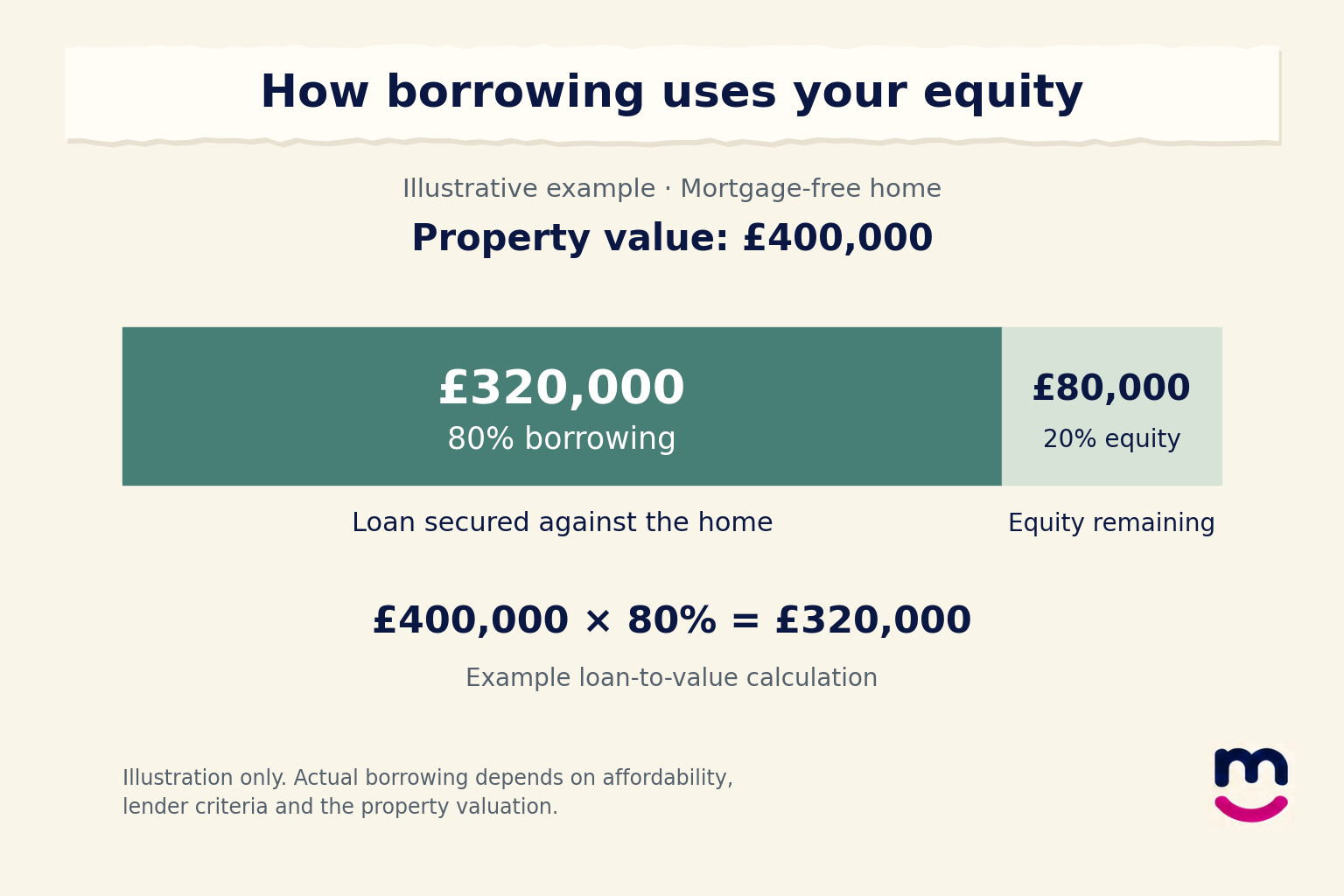
The equity formula is straightforward. Multiply your property value by the lender’s LTV cap, then subtract any outstanding mortgage. With a £400,000 property, no existing mortgage, and an 80% LTV cap, you could theoretically borrow £320,000.
Your income is what lenders look at next. Premier customers may borrow up to 6.5 times their income with an LTV of up to 90%. First-time buyers with a minimum sole income of £35,000 or joint income of £55,000 may access up to 5.5 times their income at maximum 90% LTV. Standard borrowers typically receive lower multiples. Lenders stress-test every application to verify repayments stay manageable if rates rise by 1-2%.
Secured loans typically start from around £10,000 and can reach £250,000 or more, depending on equity and income. Larger amounts over £25,000 are common with secured lending.
What Lenders Actually Look At
Affordability, not credit score, is the primary determinant for most secured loan approvals. Lenders examine your income and spending, credit history, available equity, and your property’s current market value.
A poor credit score won’t automatically disqualify you. It will, however, affect the loan term and monthly payments available to you. Check your credit score before applying — get a 7-day free trial at Check My File: https://tinyurl.com/3pynuhkv.
Age and Income
Most lenders require applicants to be at least 18 or 21. Upper age limits vary considerably — some lenders allow applications up to age 85, whilst others cap the repayment age at 70 or 75.
Accepted income sources include employed earnings, self-employment profits, pension income, rental income, and some state benefits. State and private pensions are widely accepted when lenders review affordability.
Loan-to-Value Ratios
Most secured loan lenders cap the combined LTV at around 75-80%. Drop to 60-75% LTV and you access a wider product range with stronger pricing. Some mainstream lenders stretch to 80-85%, with certain circumstances allowing up to 90%.
Unsure which option works for your situation? Get a quick rate and personalised payments on our site, or book a call with an expert on 03330 90 60 30.
The Pros, Cons and Risks of Borrowing Against Property You Own
Why Secured Borrowing Works in Your Favour
Your property does more than give you a place to live. Used as security, it unlocks borrowing amounts unsecured options simply can’t match — useful for large home improvements, significant purchases, or consolidating expensive debts. Interest rates are typically lower because your property reduces the lender’s risk. Repayment terms often stretch to 25 years or more, keeping monthly payments manageable.
Poor credit history? Lenders show considerably more willingness to approve secured loans when your home backs the borrowing. The property gives them confidence they’ll recover their funds regardless of how circumstances change.
Check your credit score before applying — get a 7-day free trial at Check My File: https://tinyurl.com/3pynuhkv.
What It Will Actually Cost You
Lower interest rates don’t tell the whole story. Repay over 25, 30 or even 35 years and total interest accumulates significantly. The monthly payment looks affordable. The lifetime cost is another matter entirely.
Fees add up too. Legal, administration, valuation and broker charges all increase what you’ll pay overall. Some secured loans carry variable interest rates, meaning monthly repayments can rise or fall with market conditions.
The Repossession Risk
Your home is at stake if you fail to keep up repayments. Lenders must follow strict legal protocols before any repossession — issuing warnings and offering hardship support first. Court involvement is required before any further action can be taken.
Should your property be repossessed and sold, proceeds are distributed among secured lenders in the order loans were granted.
Think carefully before securing debts against your home.
Inheritance and Estate Planning
Borrowing reduces your estate’s value — which affects what your beneficiaries inherit. Lifetime mortgages carry particular weight here, as interest compounds over time. That said, with inheritance tax charged at 40% on estates exceeding £325,000, reducing your estate value through borrowing can actually lower your tax liability.
It’s worth discussing with an advisor before making any decisions.
Get a quick rate and personalised payments on our site, or book a call with an expert on 03330 90 60 30.
How to Apply for a Loan Against Property
Ready to apply? Here’s what to prepare and what to expect.
Your Financial Documentation
Gather proof of identity — a valid passport or driver’s licence works well. You’ll also need proof of residence, recent utility bills or bank statements, and proof of income including payslips or tax returns. Three months of bank statements are required to demonstrate affordability. Property documents including sale deeds, title records, and recent tax receipts are essential.
Check your credit score before you apply. A 7-day free trial is available at Check My File: https://tinyurl.com/3pynuhkv. Your credit history shapes the rates and terms on offer.
Broker or Direct Lender?
Work with a broker. Around 87% of UK regulated mortgage lending is arranged through brokers — and there’s good reason for that. Brokers access the entire market and can secure rates not available directly. They handle the paperwork, chase the application, and negotiate terms on your behalf.
Going direct limits your options. We’ll search the market to find you the best deal.
The Application Process
Complete the online application with your personal details, employment type, income, and the loan amount you need. Once submitted, expect a response within 48 hours. After document verification, disbursement can follow within 72 hours.
The Property Valuation
A RICS-qualified surveyor will contact you to schedule a visit. They assess every room, take photographs, and review comparable recent sales in your area. It’s straightforward — just make sure you’re available and the property is accessible.
Speak To An Expert.
Unsure where to start with your application? Get a quick rate and personalised payments on our site, or book a call with an expert on 03330 90 60 30.
Conclusion
Owning property outright certainly gives you powerful borrowing options. You can access substantial funds at competitive rates, whether you need money for home improvements, debt consolidation, or other purposes. The key is choosing the right loan type for your circumstances and understanding the risks involved.
Your property provides excellent security, but it’s also at stake if repayments become unmanageable. Before proceeding, check your credit score with a 7-day free trial at Check My File: https://tinyurl.com/3pynuhkv. Your credit history will influence the terms available.
Get a quick rate and personalised payments on our site, or book a call directly with an expert on 03330 90 60 30.
FAQs
Q1. Is it possible to borrow money using my property as security? Yes, you can borrow against your property if you own it outright. Secured loans allow you to access substantial funds, sometimes upwards of £100,000 or more, by using your home equity as collateral. Options include remortgaging your mortgage-free property, secured loans, bridging finance, and equity release products. The amount you can borrow depends on your property’s value, your income, and the lender’s loan-to-value criteria.
Q2. How much can I typically borrow on a mortgage with a £50,000 salary? With a £50,000 salary, you could potentially borrow between £225,000 and £325,000, depending on the lender’s income multiple. Standard borrowers typically receive around 4.5 times their income, whilst premier customers may access up to 6.5 times their income with higher loan-to-value ratios. First-time buyers with minimum sole income of £35,000 may access up to 5.5 times their income. Lenders also stress-test applications to ensure repayments remain affordable if interest rates rise.
Q3. What are the main risks of taking out a loan secured against my home? The primary risk is repossession if you fail to keep up with repayments. Your home is at stake when you secure borrowing against it. Additionally, whilst interest rates may be lower than unsecured loans, extended repayment periods mean you’ll pay considerably more interest overall. Variable interest rates can cause monthly payments to fluctuate, and various fees including legal, administration, and valuation charges increase overall costs.
Q4. Can I provide an interest-free loan to a family member? Yes, you can give an interest-free loan to a relative. There are no legal restrictions preventing you from lending money to family members without charging interest. However, it’s advisable to document the arrangement properly with a written agreement outlining repayment terms to avoid misunderstandings and potential complications with inheritance or tax matters in the future.
Q5. What documents do I need to apply for a loan against my unmortgaged property? You’ll need proof of identity such as a valid passport or driver’s licence, proof of residence like recent utility bills or bank statements, and proof of income including payslips or tax returns. Lenders typically require three months of bank statements to demonstrate affordability. You’ll also need property documents including sale deeds, title records, and recent tax receipts. Checking your credit score before applying is recommended as it influences the rates and terms available.