Part and Part Mortgage Explained: How to Split Repayment and Interest-Only Payments
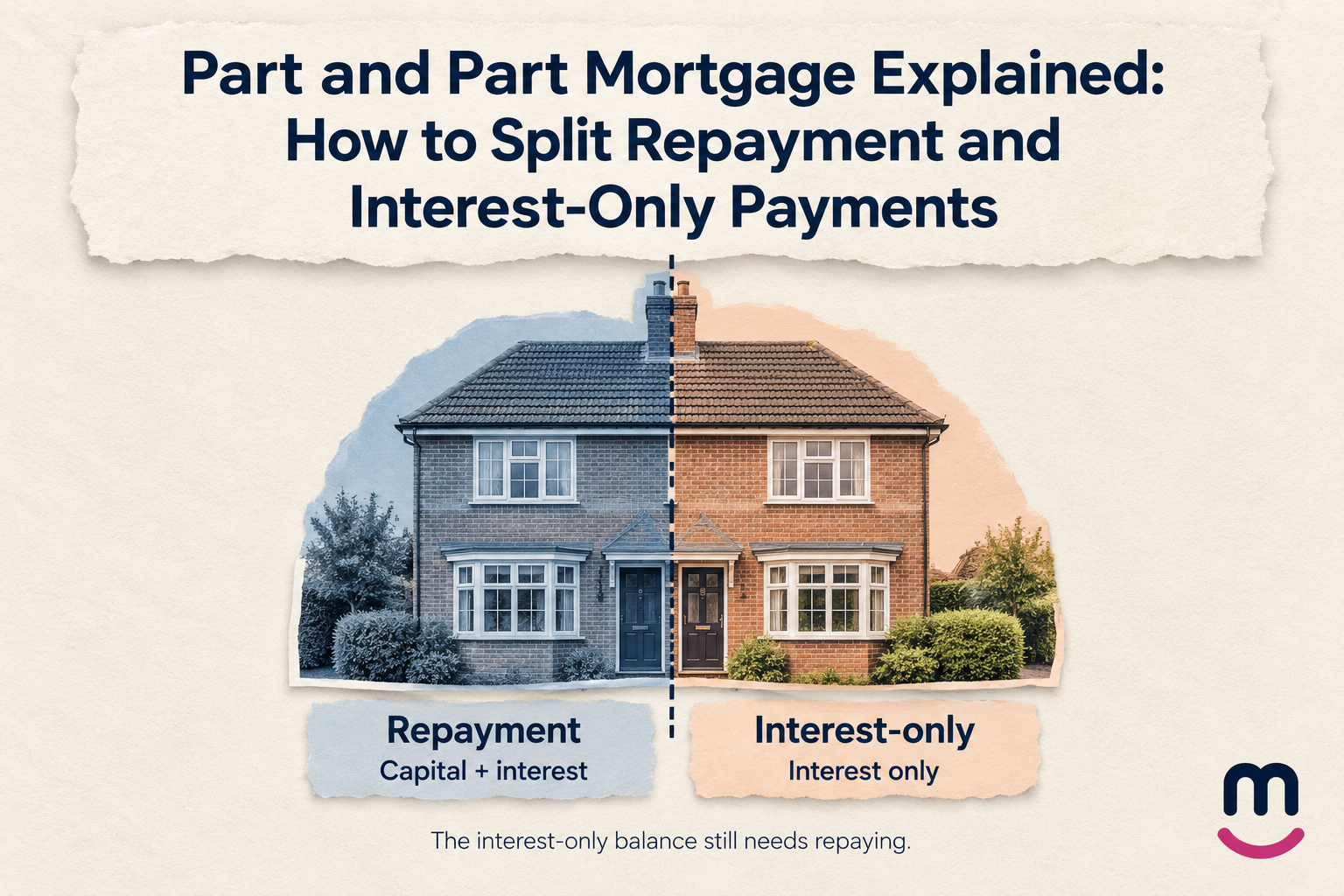

Can't decide between a repayment or interest only mortgage? A part and part mortgage splits your loan into two portions: one on a capital repayment basis and one on an interest only basis. This structure works well if you want lower monthly payments than a full repayment mortgage but less capital to pay off at the end of the term than a full interest only mortgage. Many lenders cap full interest only at 75% LTV. A part and part structure can give you access if you're above that threshold.
What Is a Part and Part Mortgage?
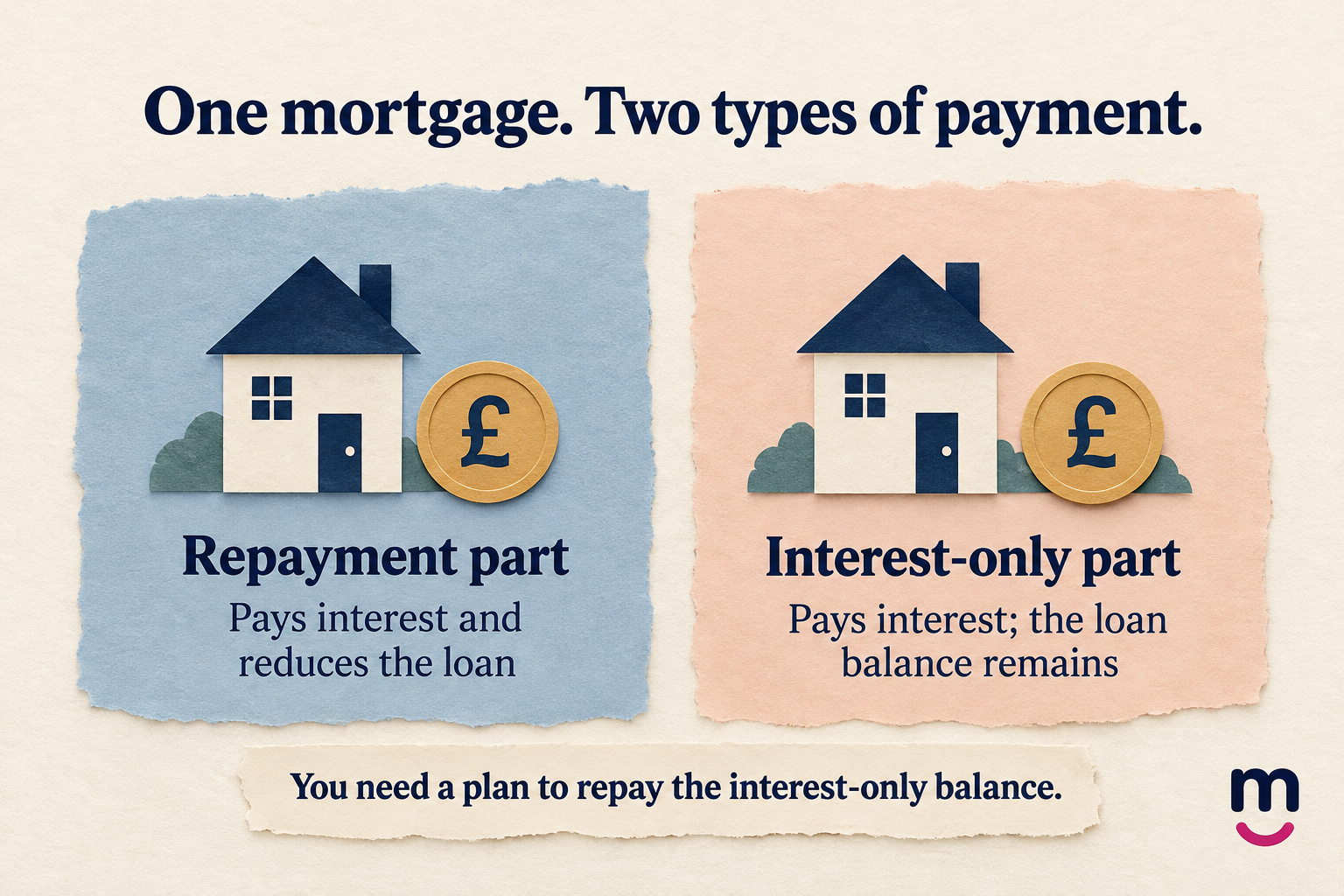
A part and part mortgage combines elements of both a capital repayment mortgage and an interest only mortgage into a single loan. One portion of your borrowing operates on a standard repayment basis. Monthly payments chip away at both the interest and the original capital. The remaining portion functions as interest only. You pay solely the interest charged each month and the capital balance stays unchanged.
How the Split Structure Works
Your lender divides the total loan into two distinct segments. You decide the proportion allocated to each part, subject to lender restrictions. A £200,000 mortgage might structure £150,000 as repayment and £50,000 as interest only. A £50,000 loan could comprise £30,000 on a repayment basis and £20,000 on interest only.
This arrangement allows you to tailor the split according to your financial circumstances. Most lenders impose maximum limits on how much can sit on an interest only basis. These limits typically link to your loan-to-value ratio. You retain some control over the proportions, but you’ll need to structure a decent chunk of the mortgage on a repayment basis to satisfy lender criteria.
Check your credit score before applying, as this affects your options. You can access a 7-day free trial with Check My File here: https://tinyurl.com/3pynuhkv to see where you stand.
The Two Payment Components
Each month, you make a single payment covering both portions of the mortgage. The repayment element reduces your outstanding balance over time. The interest charged on it falls correspondingly as this portion decreases, and more of your payment goes towards clearing the capital. This mirrors how a standard repayment mortgage functions.
The interest only portion operates differently. Your monthly payment covers solely the interest accrued on that segment. The capital amount borrowed remains static throughout the term. Take the earlier example: £50,000 on interest only at 5% interest would cost approximately £208 monthly on this portion alone. The £150,000 repayment portion at the same rate would cost around £877 monthly over 25 years.
Your total monthly outlay sits between what you’d pay on a full repayment mortgage and a full interest only mortgage. A £200,000 loan at 5% over 25 years would cost roughly £1,085 on a part and part structure, compared to £1,169 for full repayment.
What Happens at the Term’s End
The repayment portion will be fully cleared at the mortgage term’s conclusion. You’ll still owe the complete outstanding balance on the interest only element. The previous example would leave you facing a £20,000 lump sum payment at the end.
You must demonstrate to your lender that you possess a credible strategy for repaying this remaining amount. Lenders require a formal repayment plan before approving the mortgage. This plan, often called a repayment vehicle, could involve savings, investments, pension lump sums, downsizing property or selling assets.
You risk facing repossession if you cannot settle the balance at the term’s expiry without a solid plan. Get a quick rate and payment estimate on our site, or speak directly with one of our experts on 03330 90 60 30 to discuss your repayment strategy options.
How Does a Part and Part Mortgage Work?
Understanding how payments break down on a part and part mortgage helps you assess whether this structure fits your budget. The mechanics involve separate calculations for each portion of your loan, with distinct LTV requirements and flexibility in how you configure the split.
Monthly Payment Breakdown
You just need to work out the cost of each portion separately to calculate your monthly commitment. Take a £250,000 mortgage split 50/50 between interest only and capital repayment, both at 5% interest.
The interest only portion of £125,000 generates annual interest of £6,250. Divide this across twelve months and you get about £520.83 monthly. This amount covers the interest charges alone and leaves the £125,000 capital untouched.
The capital repayment portion involves both interest and capital reduction for the same £125,000 at 5% over 25 years. Monthly payments on this segment reach around £731.45. Most of this payment services interest early in the term, with a smaller fraction that reduces the outstanding balance. The proportion allocated to capital increases as time progresses, and interest charges decline.
Combine both components and you get a total monthly payment of roughly £1,252.28. This figure sits between what you’d pay on a full repayment mortgage versus a full interest only structure.
Loan-to-Value Ratios and Split Limits
LTV thresholds dictate how much you can allocate to each portion. Many lenders cap the interest only element at 50% LTV where you lack a separate repayment vehicle such as investments or savings and plan to rely on property equity. The remaining balance up to 75% LTV must sit on a repayment basis.
Higher LTV structures become available at the time lenders permit up to 85% total borrowing. Up to 75% can operate as interest only in this case, with the portion between 75% and 85% structured on a repayment basis. Nationwide applies this approach and allows part and part mortgages up to 85% LTV, with a maximum of 75% LTV on an interest only basis.
Some lenders impose stricter loan-to-income limits at the time any element operates as interest only, which is worth noting. This can affect your maximum borrowing capacity compared to a standard capital repayment mortgage.
Tailoring Your Interest-Only and Repayment Portions
You retain flexibility over the exact split between the two portions within lender criteria. A broker can model different scenarios to identify the right balance for your payment capacity and financial goals. To name just one example, increasing the repayment portion lowers the lump sum due at term end, and a larger interest only segment reduces monthly outgoings.
Check your credit score before structuring your application, as this influences available options. Access a 7-day free trial with Check My File here: https://tinyurl.com/3pynuhkv
Repayment Strategy Requirements
Lenders demand a credible repayment vehicle to settle the interest only portion at term end. Accepted strategies include property sale, savings, investments, or pension lump sums. The assessment forms part of your application, with lenders that scrutinise whether your chosen method provides sufficient funds at the time the mortgage concludes.
Get a quick rate and payment estimate on our site, or book in a call direct with an expert on 03330 90 60 30 to discuss your specific circumstances.
Who Benefits from a Part and Part Mortgage?
Part and part mortgages suit specific borrower profiles rather than serving as a universal solution. The structure addresses particular financial situations where neither a full repayment nor full interest only mortgage provides the right balance.
Borrowers Exceeding Interest-Only LTV Limits
Many lenders cap full interest only at 75% LTV and require a 25% deposit or equity. A part and part structure unlocks access to interest only on a portion of the loan if your loan exceeds this threshold, with the remainder on repayment. This arrangement proves especially valuable when you possess a 20% deposit but fall short of the 25% required to borrow on full interest only.
You should check your credit score before applying, as lenders assess this among other LTV ratios. Access a 7-day free trial with Check My File here: https://tinyurl.com/3pynuhkv and understand where you stand.
Those Seeking Lower Payments with Debt Reduction
Some borrowers want the cashflow benefit of interest only but prefer to make capital progress each month. Part and part delivers this balance through reduced payments and still clears some of the debt. This approach suits those managing tight budgets during periods like career transitions or increased household expenses, where freeing up monthly income becomes significant without abandoning debt reduction entirely.
The structure increases mortgage affordability when income or outgoings have changed and makes remortgage applications more viable. This flexibility can prove significant in securing approval if your circumstances have shifted since your last mortgage deal.
Meeting Minimum Equity Requirements
Some lenders require a minimum level of equity to remain at the mortgage term’s end on interest only arrangements. Accord Mortgages, to name just one example, mandates minimum equity of £250,000 for non-London properties and £300,000 for London properties at term end. Part of the loan on repayment helps achieve that threshold and makes the overall application viable.
Buy-to-Let Landlords and Property Investors
Property investors use part and part mortgages to balance cash flow management with equity building. The structure allows landlords to keep monthly outgoings manageable and gradually pay off the loan. This proves useful for properties in areas with strong rental demand, where maximising returns remains a priority alongside long-term financial commitments.
Landlords nearing the end of an interest only mortgage can transition to a part and part arrangement and maintain a portion of the original repayment method whilst beginning capital reduction.
Get a quick rate and payment estimate on our site, or book in a call direct with an expert on 03330 90 60 30 and discuss which structure fits your circumstances.
Part and Part Mortgage Eligibility and Lender Criteria
Lenders apply stricter criteria to part and part mortgages compared to standard capital repayment mortgages due to the interest only component. Each lender sets distinct thresholds for LTV ratios, income levels, acceptable repayment strategies and borrower age limits.
LTV Caps by Lenders
Most mainstream lenders cap the total borrowing at 85% LTV on a part and part structure. The interest only portion cannot exceed 75% LTV, with the remaining 10% structured on a repayment basis. Halifax, Nationwide, Barclays, Santander, Accord and NatWest all apply this 85% total with 75% interest only split.
Borrowers without a separate repayment vehicle who rely on property equity face tighter restrictions. Many lenders limit the interest only element to 50% LTV in these circumstances, with the balance up to 75% LTV on repayment. Skipton Building Society restricts part and part applications to a maximum 80% LTV with a 25-year maximum term.
Check your credit score before you apply, as this influences which lenders and LTV tiers you can access. Access a 7-day free trial with Check My File here: https://tinyurl.com/3pynuhkv
Income and Affordability Requirements
Minimum income thresholds for part and part mortgages stand at £75,000 for sole applicants or £100,000 for joint applicants. Some lenders require at least one applicant to earn £75,000 on joint applications. These requirements apply to basic income only and exclude bonuses or variable earnings.
Lenders conduct full affordability assessments that analyse your income against current outgoings. Some lenders apply stricter loan-to-income limits that can reduce your maximum borrowing capacity at the time any portion operates as interest only.
Accepted Repayment Vehicles
Lenders accept various strategies to repay the interest only portion. These include pension lump sums, investments, stocks and shares ISAs, unit trusts, endowments and property sale. Each vehicle requires specific evidence and minimum holding periods of 12 months[203].
Minimum equity requirements vary by region for property sale as the repayment vehicle: £300,000 for Greater London and Outer Metropolitan areas, £250,000 for Outer South East and £200,000 for all other UK regions[203]. Virgin Money sets downsizing equity at £300,000 minimum.
Age and Term Restrictions
Maximum age at mortgage term end ranges from 70 to 75 years[181]. Nationwide caps borrowing at age 70 or retirement, whichever comes sooner. Maximum terms span 25 to 40 years depending on the lender[223].
Get a quick rate and payment estimate on our site, or book in a call direct with an expert on 03330 90 60 30 to discuss your eligibility.
Key Considerations Before Choosing Part and Part
A few important factors to weigh up before committing. The interest only component triggers specific lender policies that affect your entire loan — not just the interest only portion. Future flexibility also depends heavily on your circumstances and lender appetite.
Interest-Only Policy Applied to the Entire Mortgage
Lenders apply their full interest only criteria to the whole mortgage when any element sits on an interest only basis. The repayment element typically faces a maximum term of 25 years and an age cap at 70, though this varies by lender. Some lenders impose stricter loan-to-income limits across the entire loan, potentially reducing your maximum borrowing capacity compared to a standard capital repayment mortgage.
This catches many borrowers off guard. One small interest only portion affects the rules applied to the entire deal.
Comparing Monthly Costs: Repayment vs Interest-Only vs Part and Part
Monthly outgoings on a part and part structure sit between full repayment and full interest only arrangements. The exact figure depends on your chosen split ratio, loan size, interest rate, and term length.
Your credit score influences the rates available to you. Access a 7-day free trial with Check My File here: https://tinyurl.com/3pynuhkv before comparing options.
Switching Between Mortgage Types Mid-Term
Switching to full repayment mid-term remains possible if your finances allow. Lenders reassess affordability at that point, as monthly payments increase once you begin repaying capital on the previously interest only portion. Switching mid-term means higher monthly repayments than selecting full repayment from the outset — you’re clearing the balance over a shorter remaining period. Moving from part and part to fully interest only, however, typically isn’t permitted.
Remortgaging with a Part and Part Structure
Remortgaging remains viable — whether continuing with part and part, switching to full repayment, or adjusting the split. Lenders assess your circumstances and repayment strategy afresh to confirm affordability. Worth noting that split mortgage structures can complicate remortgaging when multiple loan parts exist, as lenders aggregate all parts into a single affordability assessment.
Get a quick rate and payment estimate on our site, or book in a call direct with an expert on 03330 90 60 30.
Part and part mortgages sit in the middle ground. Lower monthly payments than full repayment. Less capital outstanding at term end than full interest only. Above 75% LTV, they unlock access where full interest only mortgages simply aren’t available.
Worth checking your credit score before you apply — it affects the rates and lenders available to you. Access a 7-day free trial with Check My File here: https://tinyurl.com/3pynuhkv
Unsure whether this structure fits your circumstances? Get a quick rate and payment estimate on our site today, or speak directly with one of our experts on 03330 90 60 30. We’ll help you find the right split.
Book a Call
Key Takeaways
A part and part mortgage offers a strategic middle ground for borrowers who need flexibility in their monthly payments whilst still making progress on debt reduction.
• Split structure unlocks higher borrowing: Part and part mortgages allow interest-only borrowing above the typical 75% LTV cap, with total lending up to 85% LTV by placing the excess on repayment terms.
• Monthly payments sit between full repayment and interest-only: You’ll pay less than a full repayment mortgage but more than interest-only, whilst gradually reducing your outstanding balance on the repayment portion.
• Strict eligibility criteria apply: Lenders typically require minimum income of £75,000 (sole) or £100,000 (joint), plus a credible repayment strategy for the interest-only portion at term end.
• Interest-only policies affect the entire loan: When any portion operates as interest-only, lenders apply stricter criteria to the whole mortgage, including maximum 25-year terms and age caps at 70.
• Ideal for specific borrower profiles: This structure particularly benefits those exceeding interest-only LTV limits, buy-to-let landlords managing cash flow, and borrowers needing lower payments whilst building equity.
The key advantage lies in accessing interest-only benefits whilst satisfying lender requirements for capital repayment, making it a practical solution when neither full repayment nor full interest-only mortgages meet your needs.
FAQs
Q1. How do part and part mortgages actually work in practise? A part and part mortgage divides your loan into two segments: one portion operates on a capital repayment basis where you pay both interest and reduce the original balance, whilst the other portion functions as interest-only where you pay solely the interest charges each month. You make a single monthly payment covering both portions, with the total cost sitting between what you’d pay on a full repayment mortgage and a full interest-only arrangement.
Q2. What’s the main difference between interest-only and repayment elements in a part and part mortgage? On the repayment portion, your monthly payments gradually reduce the outstanding balance whilst also covering interest charges, meaning this segment will be fully cleared by the end of the term. On the interest-only portion, you only pay the interest accrued each month, so the capital amount borrowed remains unchanged throughout the term and you’ll owe this full balance as a lump sum when the mortgage ends.
Q3. Why would someone choose a part and part mortgage instead of a standard repayment mortgage? Part and part mortgages suit borrowers who want lower monthly payments than a full repayment mortgage whilst still making some progress on debt reduction. They’re particularly useful for those exceeding the typical 75% LTV limit for interest-only mortgages, as the structure allows interest-only borrowing up to 75% LTV with the remainder on repayment terms, enabling total borrowing up to 85% LTV.
Q4. How much would monthly payments be on a £200,000 part and part mortgage? On a £200,000 mortgage at 5% interest over 25 years, if split equally between interest-only and repayment, you’d pay approximately £1,085 monthly. This compares to roughly £1,169 for a full repayment mortgage on the same terms. The exact amount depends on how you split the loan between the two portions and your specific interest rate.
Q5. What happens at the end of a part and part mortgage term? When your mortgage term concludes, the repayment portion will be fully cleared, but you’ll still owe the complete outstanding balance on the interest-only element as a lump sum. Lenders require you to demonstrate a credible repayment strategy before approval, such as savings, investments, pension lump sums, or property sale, to ensure you can settle this remaining balance.